Just six years ago, the first flexible foldable smartphone hit the market. It was the original Galaxy Fold, and while it certainly shook up the market, it was incredibly awkward to use. It was narrow, thick, and had huge bezels, making it difficult to use properly. And that’s where we are now. The HUAWEI Mate X6 is a foldable smartphone that overcomes one of the two main problems with such devices: it’s so thin that when folded, it’s only slightly thicker than a regular smartphone.
What about ergonomics?
The Mate X6’s bezels are even thinner than those of the iPhone 16 Plus, and the display is wide enough to use like a regular phone. It’s a fairly standard size, with a 6.45-inch diagonal. You can text, watch videos, play games, and take photos—all with the same level of comfort as a regular smartphone. You won’t feel any discomfort; you could practically use the phone for a year without opening it and not lose any comfort. Because it’s so thin, you barely notice the difference between a regular smartphone and a foldable one. The Mate X6 isn’t the thinnest clamshell in the world—there are thinner ones—but even its 9.9 mm thickness is comfortable enough to use. And that’s a true feat of engineering.
The nuances of a thin case
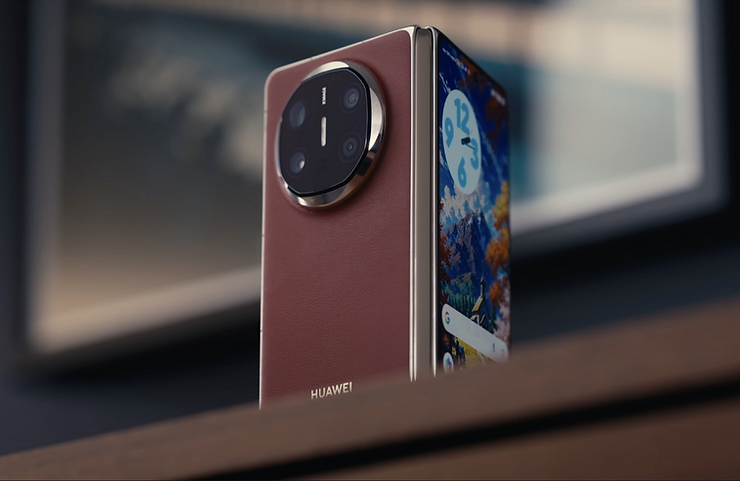
But such a thin case has its nuances. When unfolded, the Mate X6 is only 4.6 mm thick. Now add to this the fact that HUAWEI really wanted to make not just a foldable smartphone, but one that also takes excellent photos, so they added three main cameras, including a periscope zoom. The result is a huge camera block on the back. All these cameras simply wouldn’t fit inside the back cover; it’s too thin. This block is so massive that when the phone is lying flat on the back cover, a huge gap forms underneath, and the Mate X6 itself rests at a significant angle on the camera. This can be partially compensated for by the included case, as it has a kickstand at the bottom that keeps the phone level. The case is actually quite nice, with a faux leather finish, but the kickstand gets in the way a bit when holding the phone and somewhat detracts from the beauty of the thin case.
And yet, for me personally, the Mate X6’s shape is more comfortable than the Galaxy Fold’s. It’s because of the edges. Samsung’s are completely flat, making it awkward to open because there’s nothing for your fingers to grab onto. Huawei, on the other hand, has rounded, very thin bezels, making it much easier to open. Huawei has significantly redesigned the hinge. The steel construction is now stronger, yet lighter and thinner. When closed, it’s barely noticeable and doesn’t interfere with using the phone. The Mate X6 opens with little effort, locking easily at angles up to 110 degrees; beyond that, the back cover with its large camera module begins to tip over. This angle is generally sufficient for watching YouTube comfortably.
What’s with the fold?
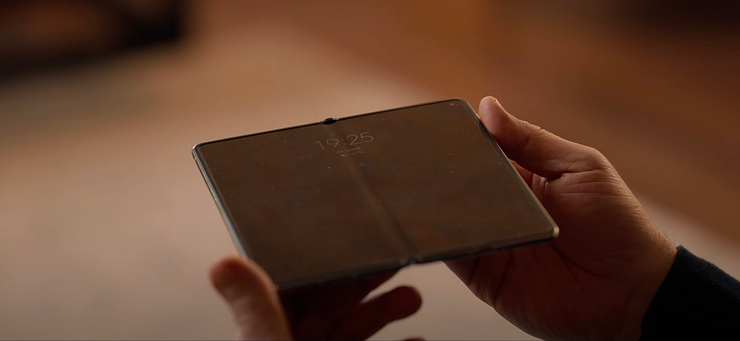
But the small hinge can’t solve the crease issue. On the Mate X6, it’s not particularly large or noticeable, but it’s noticeable. The crease doesn’t interfere with using the phone, but you should be aware that it’s not a completely flat surface. It’s noticeable. Incidentally, the inner screen is made of carbon fiber. HUAWEI promises reliable protection, but I wouldn’t test it too much or use styluses with a second-hand device; it’s not glass and can be damaged. The outer screen, however, is made of glass. It’s fairly durable Kunlun Glass 2; check out how various bloggers test it online. The phone easily survives multiple drops onto concrete and even being run over by a car. The Mate X6 also has IPX8 water resistance, but no protection against dust or sand.
Performance
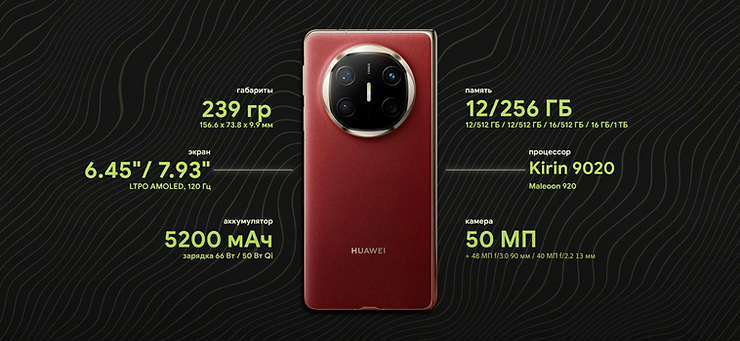
Another significant change for the Mate X6 compared to its predecessor is its move to HUAWEI’s own Kirin 9020 processor. This octa-core chip is built on a 7nm process. Essentially, it’s an improved Kirin 9010, with a 15% larger die size and other improvements. This same processor was already featured in the Mate 70 series last year, and it’s clear that it doesn’t quite measure up to the top-end processors in terms of raw performance, as you’ll see in benchmarks. However, it’s worth noting that the phone’s real-world performance is sufficient. It’s very fast, with no stuttering whatsoever, and the transition from the external screen to the main one is seamless and very smooth. There are some nuances in games, and not all are well optimized for this smartphone, but popular titles like Genshin Impact run reliably at 60 fps with minor drops. It’s also worth noting that HUAWEI has done a pretty good job of dissipating heat in this smartphone using graphene and a vapor chamber. For such a thin device, the phone doesn’t get very hot, but throttling is still present. Interestingly, the phone heats up slightly differently when open than when closed, and throttling occurs accordingly. HUAWEI even recommends charging this phone open.
About the Author